LVA 253.O64 BA Design Studio S26 15.0 ECTS
Supervision: Markus Planteu
The concrete design task deals with the densification of urban residual areas at selected locations in Vienna.
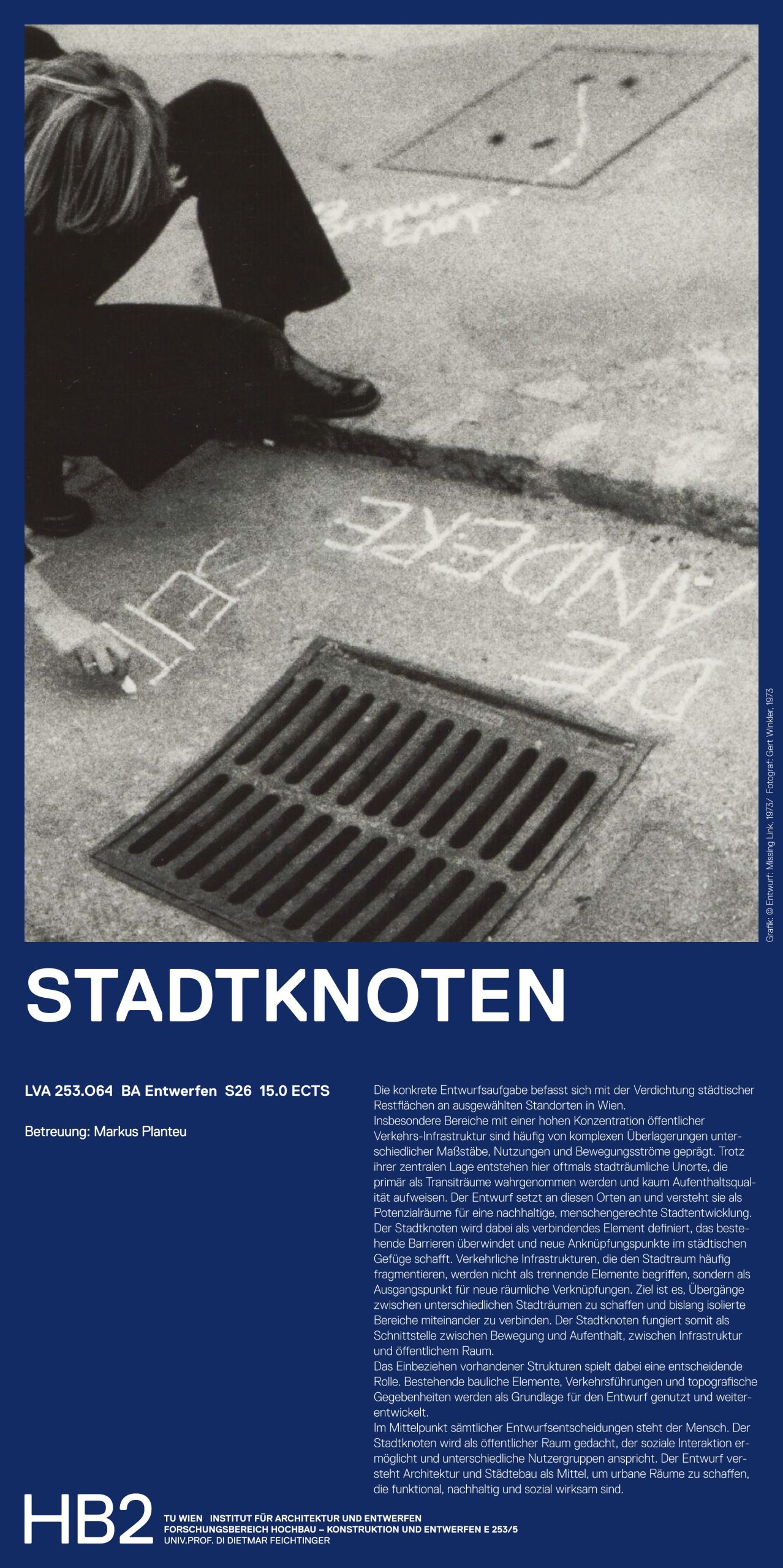
In particular, areas with a high concentration of public transport infrastructure are often characterised by complex overlaps of different scales, uses and flows of movement. Despite their central location, urban spatial non-places often emerge here, which are primarily perceived as transit spaces and display hardly any quality of stay. The design addresses these places and understands them as potential spaces for sustainable, human-oriented urban development.
The urban node is defined as a connecting element that overcomes existing barriers and creates new points of connection within the urban fabric. Transport infrastructures, which often fragment urban space, are not understood as separating elements, but as a starting point for new spatial linkages. The aim is to create transitions between different urban spaces and to connect previously isolated areas with one another. The urban node thus functions as an interface between movement and stay, between infrastructure and public space.
The inclusion of existing structures plays a decisive role in this process. Existing built elements, traffic routes and topographical conditions are used as a basis for the design and further developed.
At the centre of all design decisions stands the human being. The urban node is conceived as a public space that enables social interaction and addresses different user groups. The design understands architecture and urban design as a means to create urban spaces that are functional, sustainable and socially effective.